
AI is the new over-Photoshopped photo, and brands need to stop
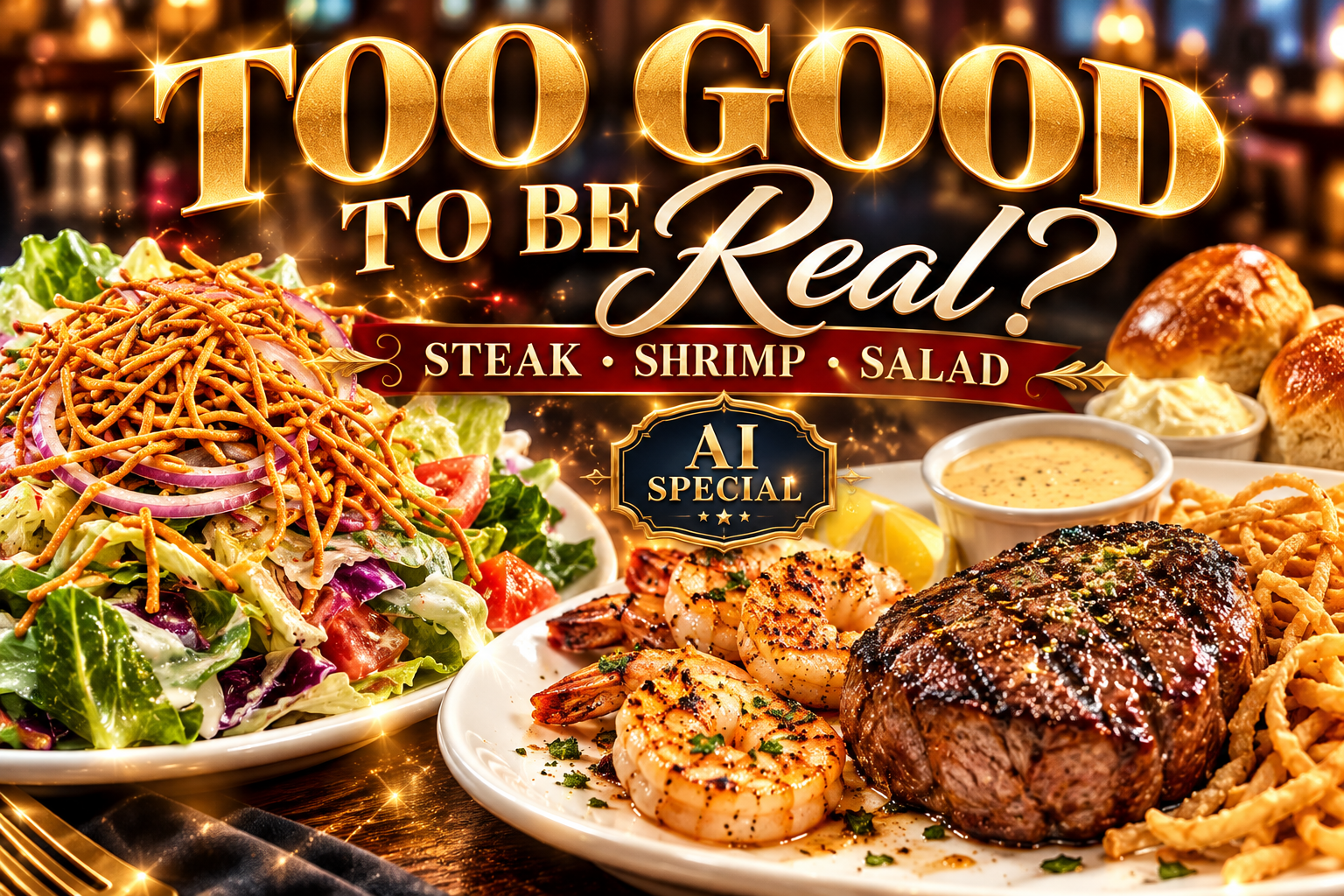
AI-generated graphics are taking over social media, and they don't necessarily do brands any favors.
You've probably noticed them. The impossibly perfect food photography, the suspiciously flawless lighting, the elaborate backgrounds and the oversized typography that looks like it belongs on a movie poster. Everything is shiny, dramatic, and just a little too perfect. Sometimes the images are so obviously artificial you wonder how they made it through approval.
It's particularly noticeable in restaurant marketing, where sandwiches are stacked impossibly high, cheese melts in ways that defy physics and every ingredient looks like it was individually styled for a magazine cover. But the problem extends well beyond food. From retail promotions and event announcements to professional services and real estate, AI-generated graphics are appearing across nearly every industry, often with the same exaggerated visual style.
The more we see them, the harder it becomes to distinguish one brand from another.
We've seen this before
Remember when Photoshop became the answer to everything? Suddenly, every photograph was aggressively retouched, every sky was impossibly blue and every person looked like they'd been airbrushed into another dimension. What started as a useful creative tool became an excuse to manipulate images until they barely resembled reality.
AI-generated graphics feel like the next evolution of that problem, except the process is now faster, cheaper and accessible to practically anyone. Instead of spending hours editing a photograph, businesses can generate elaborate promotional images in seconds. The technology is impressive, but the results often feel more like a demonstration of what AI can do than a thoughtful piece of marketing.
I'm not anti-AI. Far from it. At treadsocial, we use AI for research, brainstorming, organizing information, exploring creative directions and making certain aspects of our work more efficient. It can be an incredibly valuable tool when used thoughtfully. But there's a significant difference between using technology to support the creative process and letting it replace the judgment, experience, and originality that make creative work effective.
Good design requires more than producing something visually impressive. A skilled designer understands typography, composition, visual hierarchy, brand standards and the audience a piece of content is intended to reach. Designers know when to simplify, when to make something stand out, and when an image or design treatment doesn't fit the message. AI can generate a polished-looking graphic, but that doesn't automatically make it good design.
Food marketing has a particularly big problem
Of all the industries embracing AI-generated imagery, restaurants may have the most to lose.
Food photography has always involved styling, lighting and careful presentation. Nobody expects the burger that arrives at their table to look exactly like the one photographed for a national advertising campaign. But there's an important difference between making real food look its best and creating an entirely fictional version of a menu item.
When a restaurant uses AI to promote a sandwich, pizza or entrée, it risks presenting something customers can't actually order. The bread is perfectly toasted, the ingredients are arranged with impossible precision and the portions may be far more generous than anything coming out of the kitchen. The image might attract attention initially, but it can also set expectations the restaurant can't realistically meet.
Worse, these overproduced images practically invite negative feedback on social media.
We've all seen the comments beneath an overly polished restaurant advertisement. Someone responds with a photo of what they actually received, often with a sarcastic remark about the difference between the advertised product and reality. Other customers join in, share their own experiences, and suddenly the conversation shifts away from the food the restaurant wanted to promote.
Instead of generating excitement or encouraging a visit, the post gives customers a reason to question the brand's credibility. Because social media makes those comparisons public, a single customer photograph can undermine the original promotional message far more effectively than a lengthy written complaint.
This isn't entirely new. Restaurant advertising has long been criticized for unrealistic food photography. However, generative AI makes it easier than ever to create exaggerated imagery without the expense or effort traditionally associated with professional production. What seems like an inexpensive creative solution can ultimately create a much more expensive problem if customers start questioning whether the brand represents its products accurately.
For restaurants, authenticity isn't simply a creative preference. It's directly connected to consumer expectations and trust.
When real photography becomes a competitive advantage
I recently read a Futurism article examining restaurants and the growing backlash against AI-generated food imagery. What struck me most was the idea that restaurants can attract attention by emphasizing that their food photography is real.
Think about how strange that is. We're reaching a point where showing customers an actual photo of the food being served can become a key part of a restaurant's marketing.
For years, marketers have talked about authenticity on social media. We've encouraged brands to show behind-the-scenes moments, introduce employees, highlight customer experiences and share content that feels less manufactured. Audiences have demonstrated an appetite for genuine interactions and a look at the people and personalities behind the businesses they follow.
At the same time, we're watching businesses replace those authentic visuals with artificial images that often have little connection to the experience they're selling.
The contradiction is difficult to ignore. A restaurant has a kitchen full of food, employees preparing meals and customers enjoying themselves, yet its social media feed features a computer-generated sandwich. A business hosts a successful event with real attendees and meaningful moments but chooses to promote the next one using a fictional crowd. A retailer has merchandise, employees and an actual storefront but relies on generic AI imagery that could belong to almost any company.
In each case, the business already has something more valuable than an artificial image: a real story to tell.
Good photography and thoughtful design are still worth the investment
I understand why AI-generated graphics have become so appealing, especially for small businesses with limited marketing budgets. Professional photography, graphic design, and content production require resources, and not every organization has an in-house creative department or can schedule regular photo shoots.
But you don't have to choose between expensive professional production and completely artificial imagery.
Smartphones can produce excellent photographs when someone pays attention to lighting, composition, and the subject. A modest investment in professional photography can also create an asset library that supports months of social media content. And a graphic designer can develop a collection of branded templates that make routine promotions easier to produce while maintaining a consistent visual identity.
For restaurants, even a relatively simple photograph of an actual menu item can be more compelling than an elaborate AI-generated version. Show the sandwich that comes out of the kitchen. Capture the pizza as it's being sliced. Photograph the chef preparing a dish or the dining room during a busy lunch service. These details help customers understand what makes a restaurant worth visiting.
The same principle applies to other industries. A real employee, an actual customer experience, a completed project or a genuine behind-the-scenes moment often communicates more about a business than a highly stylized promotional graphic.
That doesn't mean every photograph needs to be perfect or that every piece of content must be professionally produced. In fact, some of the most effective social media content succeeds precisely because it feels spontaneous and genuine. The goal should be to create visuals that are interesting, recognizable and appropriate for the brand, not simply to produce the most elaborate image possible.
AI certainly has a place in visual content creation. It can help with conceptual imagery, illustration, brainstorming, and campaigns where the artificial nature of the creative is intentional. The issue isn't whether AI was involved in producing an image. It's whether the finished product communicates the right message, accurately represents the brand and gives audiences a reason to trust what they're seeing.
The risk of looking like everyone else
Beyond authenticity, another problem with the growing reliance on AI-generated graphics is that brands are beginning to lose the visual characteristics that make them distinctive.
When every promotional post features dramatic lighting, oversized lettering, glossy textures, elaborate effects and exaggerated imagery, the content starts to feel interchangeable. Remove the logo, and it becomes hard to tell which business created it.
That's the opposite of what effective branding should accomplish.
A strong visual identity should make a brand recognizable before someone even reads the company name. It should reflect the business's personality, its audience's expectations, and the experience customers can expect. Developing that identity takes thought, consistency, and a willingness to make creative decisions not driven by the latest trend or technology.
The temptation to produce more content, more quickly, is understandable. Social media demands a steady stream of material, and AI offers an appealing shortcut. But increasing content volume does little if the result is a feed full of generic graphics that audiences scroll past or, worse, openly criticize.
At treadsocial, we believe technology should help make good marketing better. We're enthusiastic about tools that improve efficiency, support creativity and make it easier to execute strong ideas. But we also believe in the value of experienced writers, talented designers, authentic photography and the judgment required to know when something simply doesn't look right.
AI-generated graphics may be the new over-Photoshopped photographs, but brands don't have to repeat the same mistakes. Showing people what a business actually looks like, what it really creates, and who is behind it still has tremendous value.
Sometimes the most effective creative decision isn't to write a better prompt. It's to pick up a camera, work with a designer and show people what's actually there.